More demand paths don’t always mean more buyers. This article explores how duplication across the supply chain leads to bid throttling, noise, and lost publisher revenue.
Here is a question most publisher teams cannot answer clearly: of all the demand sources calling your inventory right now, how many are genuinely different buyers?
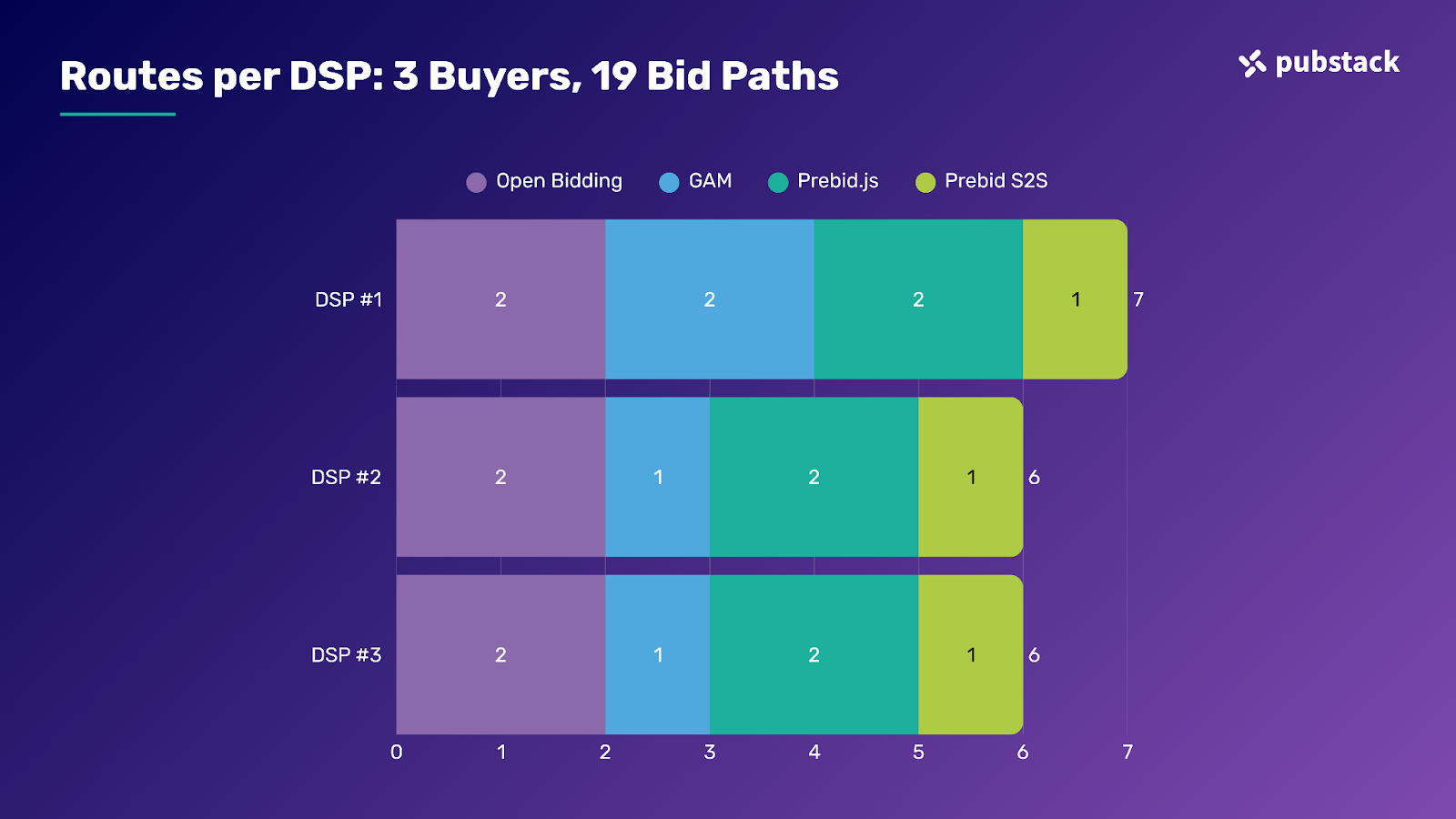
In one real-world mapping exercise, Pubstack traced a standard enterprise configuration with 19 active bidders across header bidding, Open Bidding and server-side integrations. When those routes were mapped back to the underlying buyers, they turned into three global DSPs, each appearing through six or seven different paths. Same buyers, different masks.
Most publisher monetisation teams have historically had the same reaction when revenue has been facing pressure. Add another path. Another integration. Another “just in case” path to demand. The stack grows. The auction looks busier. And yet the numbers often become harder to trust.
That is the problem hiding behind a lot of modern programmatic setups. The supply chain has added routes faster than it has added understanding. Under QPS and processing constraints, buyers do what scaled systems do to protect themselves. They prioritise what they can evaluate, they filter earlier, and publishers experience the result as bid throttling.
This is the part publishers do not see: revenue you never knew you lost.
This is not an edge case. Many publishers experience this today, and it helps explain why “more demand” can still produce less value.
In 2014 header bidding really was a breakthrough. For publishers trapped in waterfall mechanics, simultaneous access to multiple demand sources changed everything. Better auctions. Better revenue. More paths meant more demand.
But budgets did not increase. Complexity did.
As the same impression began travelling through more SSPs, resellers, wrappers and ad servers, often to reach the same underlying buyers, DSPs were asked to process more requests to reach the same demand. Their response was to make prioritisations under pressure: reduce QPS, focus their evaluation on what looks valuable, and protect infrastructure costs.The end result for publishers was throttling: fewer responses, more inconsistency and less certainty.
SSPs adapted with upstream filtering. Publishers, seeing fill soften, added yet another partner.
Each move made sense on its own. Together, they created a loop where everyone optimises locally and the overall market becomes noisier, less efficient and harder to read.
You invested in the content. You know the audience. You built a case for why your inventory is premium. Then the bid comes back lower than it should, or it does not come back at all. It’s not because the inventory isn’t premium, but at the final decision stage no one could tell.
This is not a technical problem on a dashboard. It is a commercial one. True revenue potential has been minimised because your best opportunities are not being evaluated in a consistent way.
When DSPs throttle, they are prioritising which bid requests to process because they can’t handle them all. If the same impression reaches the same buyer through multiple paths, and the signals do not make the inventory value clear and easy for buyers to evaluate, it becomes easier to dismiss. Not because your content is not premium. Because, at the final point of decisioning, buyers don't have a reliable way to understand which opportunities deserve deeper evaluation.
That is how commoditisation happens. High-value moments get filtered along with low-value noise. When they do not get a fair look, they do not get a fair price.
Everyone in the chain is acting in their own interest, which is why it’s hard to fix.
DSPs protect processing costs by prioritising what is easiest to evaluate. SSPs build filtering upstream to anticipate those preferences. Publishers respond to softer fill by adding routes, which increases duplication and noise, and triggers more filtering.
Publishers are also starting to limit auctions by tightening timeouts, removing supply paths, and shaping demand. Without visibility, sensible decisions can still produce irrational outcomes: more plumbing and less predictable value. And when buying strategies shift overnight, publishers are left reacting after the fact, with no clean way to influence the decisioning that shaped the result.
Bid throttling is the symptom. The core issue is that the buy side holds most of the decision-making power, while the supply side has limited ability to make inventory value clear and easy for buyers to evaluate, consistently at the impression level, in real time.
This is not buy side versus sell side. It is the ecosystem reacting to noise and weak differentiation, and everyone ends up paying the price through wasted processing and inconsistent outcomes.
The industry does not have a “quality problem”. It has a decisioning imbalance.
Premium publishers often say their audiences, brand safety and editorial environments set them apart. That’s true. But if those qualities aren’t clearly visible when buying decisions are made, they won’t consistently influence where spend goes.
Supply Intelligence that makes supply identifiable (what is this impression, really?), differentiable (why is it worth more?), and decisionable (how should it be traded, now?).
In practice, that means three things working together:
This strengthens the quality that prevent less valuable inventory from undermining buyer decisions.
Header bidding increased access, but it also amplified duplication and noise. More routes are not a strategy. Better decision making is.
Do not start with another demand audit. Start with a simpler question: do buyers actually understand your inventory at time to bid ?
Three things to check:
Programmatic does not need more volume. It needs more sense. And the path from “we are premium” to “the market can reliably recognise and pay for it” is paved with packaging, shaping and signal quality.
This analysis draws on aggregated, anonymised data from the Pubstack platform across our network of premium publishers. The bid route analysis cited reflects a real-world publisher configuration.